Eric, Keri, Tanner, Austin, Carson & McKenna

Sunday, July 15, 2012

Barcelona Day 4: Sunday


Eric located a branch of the church in Barcelona and obtained their meeting schedule. The meeting place was near Tanner’s hotel so we thought we would get him to come with us, but he had other plans with the team.

We love attending church in the different places we travel.  It is like a home away from home.  The branch members were so friendly.  Most of the missionaries were from America so I could converse with them.  The one that was a Spanish native shared his struggle with learning the Catalan language.  That made Eric smile.  We met a few couples that were travelling and got to share our experiences and adventures. 


We had taken the metro to church, but decided to walk along the Mediterranean Sea to get back to the hotel as we had not explored this part of the city yet.  It was beautiful.  The beach was pretty steep and crowded AND European (be careful to not look at the pictures too long or you might see something you don’t want to).


We thought this was a safer beach view.  The water felt GREAT!

We knew that on Sunday the City’s Historic Museum in the Gothic quarter was open to the public on Sundays for free.  So we started walking that direction ( It was a little farther than we thought, so we took advantage of the fun sights along the way). 

Eric on the Ramblas, with the street behind him that leads toward our hotel.

City Center:  The palace behind us looking toward its city and the sea.
Finally we ended up getting on the metro for the last several blocks.  As part of the museum tour we were able to walk under the Palau Reial Major, the royal residence of Isabella and Ferdinand and the courtyard where Columbus presented them with his findings of the New World.   


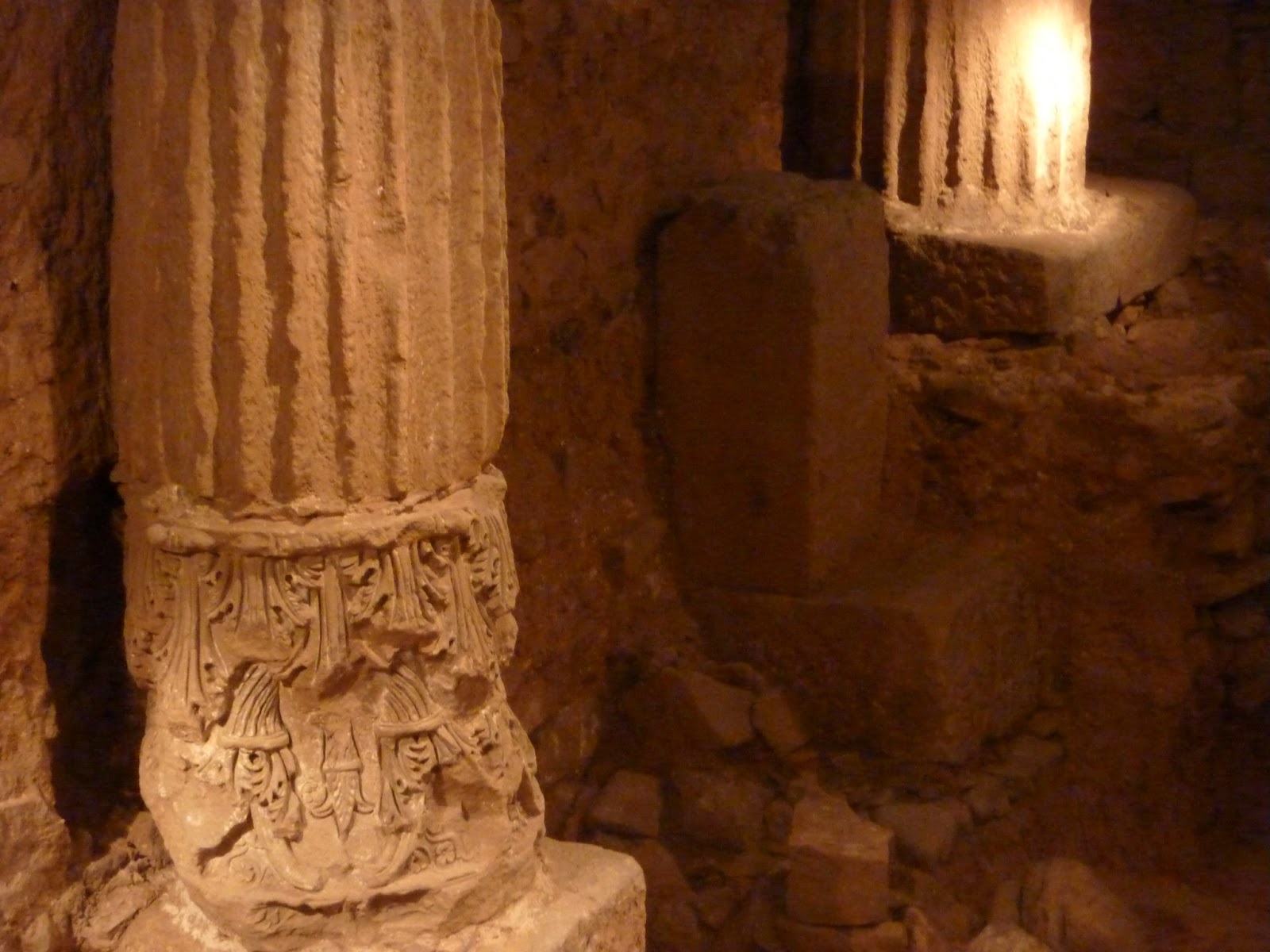
We took a step back in history to the first Iberian settlement through current-day Barcelona history all layered on top of one another.  We were able to look at the ruins of a Roman city, beautiful tiled floors,wall murals, and decorative columns.  


Each layer of the ruins told a different story of Barcelona’s past, its inhabitants, and its industry. Under the buildings and courtyards we had walked of the Gothic quarter there was a whole Roman City. being excavated.

Romann ruins under the Natural History Museum, the Palace and its courtyard.

Intricate Tiled Floor
Columns, Carvings and Headstones
After seeing all that history to walk out on the streets of the Gothic quarter you could be easily transported into another day and age.  There was a street performer that was dressed as a leper and did a great job portraying what it must have been like for them during the times of the Roman Empire.


There were also very talented musicians nestled in corners around the Gothic quarter.  Their music was beautiful and the ancient stone walls provided great acoustics for their performances. 


We saw all sorts of talents and amazing things being shared.

It was very fun to be walking in a city that had such an ancient history and see evidences of cultures that up to this point I had only been able to study in books.

We took the funicular (tram) back up Montjuic to see the closing ceremonies of the World Junior Championships.  We were so proud to see Tanner among team USA representing our country abroad.  We said our goodbye’s to him and sent him off with the team.  

International Friendships
Back at the hotel we bumped up the air conditioning and fell onto the bed with our feet propped up while we planned out our next two days of touring.  There was so much to see and do and not a lot of time left to do it in.

Saturday, July 14, 2012

Barcelona Day 3: Catalonian History and Culture

With Tanner out of the running for the gold, we had a few extra days to sight see.  We tried to get Tanner to join us, but he was pretty content to hang out with the team and his BYU coach who had served his mission in Barcelona, Spain, we decided not to wait for him any longer.  He was having his own experience.


I was so awed by what I learned about Gaudi the day before on our walking tour, I was interested in delving a little deaper into his life and his art.  We chose to return to Casa Batlló and tour the inside and hear the story behind the façade.  Casa Batlló is part of the Manzana de la Discòrdia (Apple of Discord)on Passeig de Gràcia.  Three rivaling architects were commissioned to build houses for prominent families in Barcelona.  All three had a style of their own and did not blend well together on the street.  By far, Gaudi’s Casa Batlló was the most captivating.  I love how Fodor’s tour book of Barcelona describes the scene:  “Of the three, Gudi’s Casa Batlló, with its undulating dragon backed roof, multicolored façade, skull-and-bones balconies, and underwater interior is the most remarkable.”  


It definitely caught my attention and imagination.  Gaudi’s use of Catalonia’s nationalistic symbolism dates back to the middle ages in the time of King George (St, George) and his crest with the impaled Dragon of Evil.  The skulls and bones represent the victims of the dragon.  You definitely get the feel of medieval chivalry and religious zeal that permeated this time period.  Not only did Gaudi’s work inspire imagination but also ingenuity.  He was on the forefront of blending form and function in design and architecture. It was a thrill to walk through his work and see his attention to details not only in appearance, but comfort to its inhabitants. 


Following the Casa Batlló we went to the Casa Mila, another of Gaudi’s commissioned homes.  The façade of the Mila does not awaken the imagination as the Casa Batlló does, but the interior (which we were able to enter due to an art exhibit taking place that weekend, otherwise it is closed to the public) felt like you were walking into one of Claude Monet’s paintings.  It was beautiful!

Casa Mila


Everyday walking to and from our hotel we passed Gaudi's Palau Güell. Now we had to plan a day to see Park Güell; Gaudi’s vision of a planned housing development for the rich of Barcelona set on the hill above the city and my study of Gaudi would be complete. 

Palau Guell Entrance
In the later afternoon we happened upon a Catalan Festival and got to dance the national dance with true Catalonian’s and see many other traditions of Catalonia, including the art of people stacking, called castling.


One of the great Basilica’s in Barcelona is the the Santa Maria Del Mar.  The story behind this basilica was the basis for the historical fiction book I chose to read on this vacation.  I am so glad I learned about this great structure and the care the people took to build it.  The simplicity of the Gothic architecture is the polar opposite of the Basilica of the Sagrada Familia.  The heart and the soul of Catalonia can be found here.  This place of worship was built by the common people.  Each stone was quarried on top of Montjuic (where the Olympic stadium now sits)by hand and carried upon the backs of the bastillos (seafarers) on their days off.  The women and children of the town would provide them with water and food as they hauled the large blocks.  It was a right of passage for boys to begin carrying the stones when they were strong enough.  They would start with the smaller stones and work their way up to the big ones as they developed into adulthood.  This building united the common people in a great cause and gave them a sense of pride and devotion to their way of life.  Maybe I felt so much for this building because of its similar history to a building that is so important in my family history, the Salt Lake Temple of the Church of Jesus Christ of Latter-day Saints.


We returned to the hotel exhausted.  It was quite a day of sight-seeing, and we had learned so much about the culture and people of Catalonia:  We learned why the shepherd of Catalonia always held a special spot in their nativity scenes, we were able to dance the national folk dance with a group of Catalonia nationalists, and see some of their festival dances - one honoring their countries heroes and one telling the story of the Savior's mission on the earth.

The Shepherd of Catalonia
Catalonians doing their national folk dance -
they let us join in with them!
Dance to honor the brave men (Lion) who fought under the
Catalonian flag and less than stellar leadership (Donkey).
Representation of the Death of Christ
Representation of the Resurrection of Christ
We learned why Eric’s Spanish wasn't quite cutting it in Barcelona and why he didn't understand some of the words he saw and heard. The native language of Barcelona is Catalan, a cousin of Spanish.  This made communicating and adventure in and of itself.  We needed additional wash rags at the hotel and we could not get our need communicated to the hotel staff.  They kept bringing us hand towels.  After a few tries we just laughed and used the hand towels they kept bringing us.  


In preparation for church I decided I needed to wash my hair, but still had a stiff neck.  Eric said he would help me blow dry it.  We were using the proper electric converter for the plug, but we still blew a hotel fuse.  Eric had a fun time trying to explain that to the hotel staff and get them to reset the breaker for our room.   This communication gap not only made working with the hotel staff difficult, but made every food order an adventure and using public transportation very interesting as the signage throughout Barcelona was in Catalan also.

Friday, July 13, 2012

Barcelona Day Two: The Basilica of the Sagrada Familia


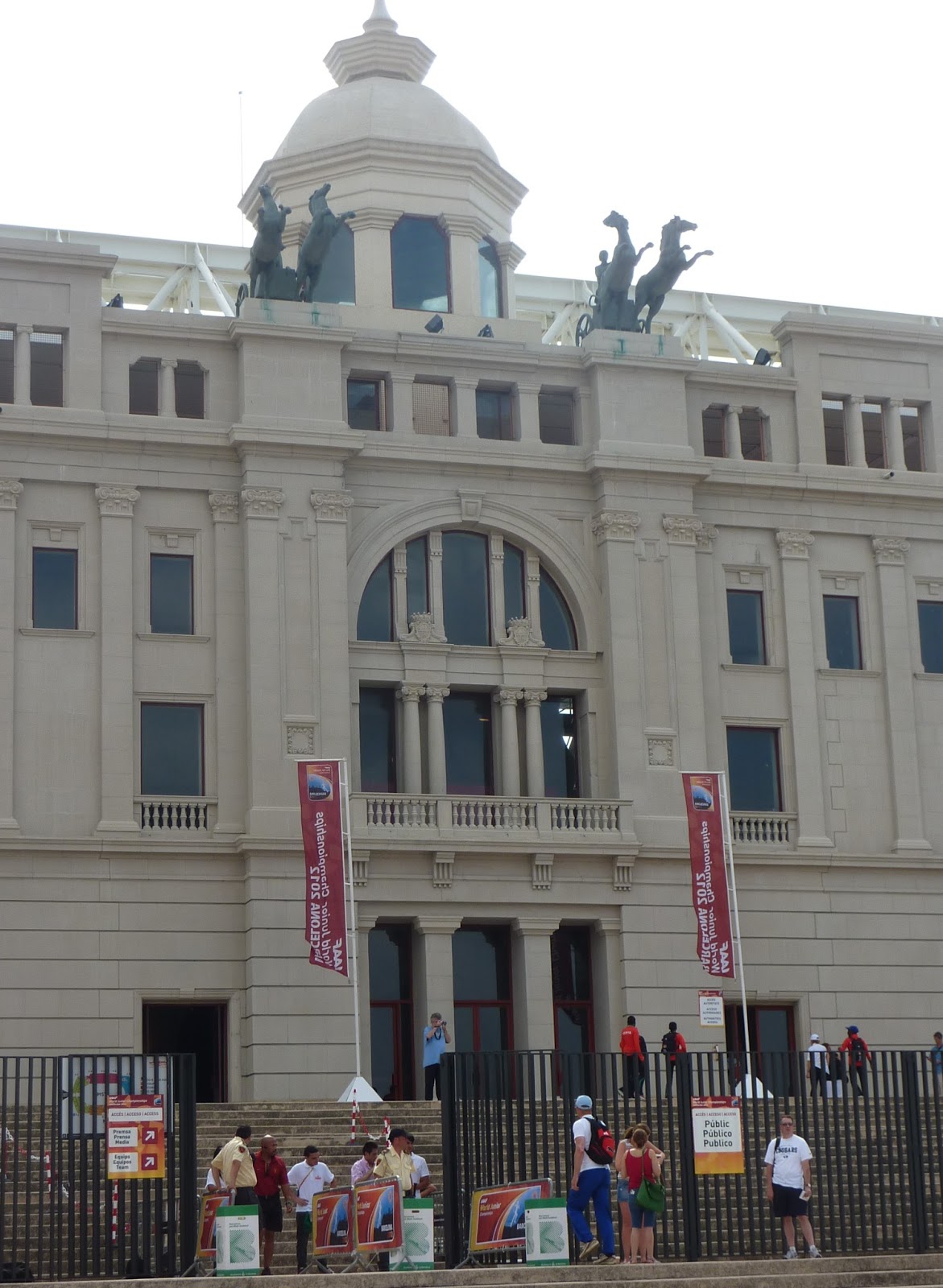
Just across Montjuic from the stadium is the Museum of Art.  It used to be the palace and place of government in Barcelona.  The architecture was grand and the grounds were beautiful.  At the front doors you could see the expanse of Barcelona.  I could imagine royalty looking out upon their kingdom and thinking of its interests and how to govern.  From the bottom, the palace demanded your respect and attention. Oh, what would it have been like to live in that day and age?  I was disappointed all the fountains were off when we were there.  None of the fountains were running throughout the city the week we were there.


We enjoyed a delicious lunch at La Taxidermista in the Placa Reial.  Once a natural science museum and taxidermy shop.  This was one of the best meals we had the whole time we were in Barcelona.  Eric had these lovely shrimp and I had the best tasting salmon! 


Eric says, "We're having a ball in Barcelona!"
Following lunch we were able to catch another walking tour with the Walking Bean Company.  We had enjoyed our tour through the old city and the knowledge we gained from the guide so much, we decided this would be a great way to see the artistic works of Antoni Gaudi.  I have had the opportunity to study his work in humanities classes and then to teach it several times in the elementary art discovery program.  He was never one of my favorite artists.  In fact, I hated his work.  I thought it was ugly and odd.  How differently I feel about Gaudi and his work now.

Palau Guell 
The first piece of Gaudi’s work we saw was the light post the country had commissioned him to build in the square.  The government never commissioned Gaudi again.  He was too difficult to work with and eccentric.  Yes, it is from Gaudi’s work that we get the adjective “gaudy” to describe something that is overly decorated, extravagant and ornate.  He also wasn't very good at sticking to a budget

Casa Batllo
We then circled the city and saw several of his great architectural works that were commissioned by the wealthy residents in Barcelona.  We got to hear about his working relationships and how Gaudi told a story and manifested his beliefs through his works.  What is particularly amazing is these buildings that look quite modern were actually built at the turn of the 19th century.

Casa Mila
The tour ended at the Basilica of the Sagrada Familia.  The pictures I have seen of this building do not do it justice.  I always thought it looked like a big mud dauber’s nest.  Up close you can see the details in the work.  What I thought were daubs of mud, were actually representations of constellations in the heavens that evolved around the star of Jesus’ birth.  There were also drifts of snow and icicles represented around some of the scenes.

The Star of Bethlehem surrounded by angels
and other constellations announcing Jesus Christ's Birth.
This building is awe inspiring, thought provoking and a truly sacred place.  The construction on the cathedral began in 1882 under the architect Francisco Villar, who resigned in 1883 and was replaced by Antoni Gaudi.  Under Gaudi’s care the cathedral designed to be a tribute to the Holy Family began to take shape.  The Sagrada Familia became his life’s work and he gave himself to it until the day he died.  In the Sagrada Familia you can see the relationship Gaudi had with God and his understanding of God’s plan.  You can also feel through the architecture and facades of this building the importance of the mission of Jesus Christ to our personal salvation. 


This cathedral, now a basilica, has three main sides.  Each side represents a different part of Christ’s life:  The Nativity, The Passion of Christ and The Glory of Christ. 


The Nativity Façade has three doorways: Charity, Hope and Faith.  The Charity doorway tells the story of the events leading up to the Savior’s birth.  The Hope doorway tells the stories of the gospels where hope was sustained through adversity through belief in Christ and Salvation.   The Faith doorway shows us pictorially passages from the gospels where faith was shown through obedience.  The Nativity facade was the only facade Gaudi was able to work on and complete before he died.  The rest of his vision is being carried out by other artists and architects following the plans Gaudi left behind.

Keri in front of the Sagrada Familia: Charity Doorway
The Passion of Christ façade tells Christ’s story from the Last Supper to the Crucifixion and is just being completed.  The sculpting on this side is not as realistic as Gaudi’s work on the Nativity side.  You can definitely tell it is a different artist. The shapes are much more square and sharp.  I didn't like it as much as Gaudi’s work, but the harsher lines lend themselves well to the telling of this part of the Savior’s life – the betrayals, the sacrifice that was made for each of us, and the pain and sorrow that accompanied all of it.

Sagrada Familia: Passion Facade
The depiction of Christ's trial on the Passion Facade of Sagrada Familia
The last façade is in its beginning phases.  The Glory facade will tell of Christ’s resurrection and triumphal return to reign.  The apostle towers are the towers currently being built.  They are the small towers. Mary, Joseph and Jesus towers are still to be built and are much larger than these.  You can see the scale of the building in the picture below.  The darker plaster is what has already been built.  The white plaster is what still needs to be done.  When completed, this building will dominate the skyline.

The model of the completed Sagrada Familia
The inside of the building is equally as grand and thought provoking as the outside.  Gaudi looked to nature for inspiration in all his designs.  He was the visionary who brought light and air into the cathedrals with his innovative columns.  These columns branched out like trees at the top to support the massive structure very unlike the heavy stone arches and buttresses used in other cathedrals.  Gaudi’s columns gave more space to the room allowing for beautiful stained glass windows and natural light to filter in.  You felt like you were under a canopy of trees on a bright sunny day – I was in a sacred grove.  The light and space in the room lifted my spirits and helped me feel the Lord’s love and desire to take my burdens from me. This was a stark contrast to the feelings of the other cathedrals we had toured.  The height of the ceiling and the beautifully tiled sunbursts with the light reflecting off of them was a tribute to God’s grandeur and beautiful creations.  I could feel God’s love in all that he had created for me as Gaudi had used them as inspiration for this sacred place.

Looking up through the trees to the heavens inside the Sagrada Familia


Gaudi’s final resting place is in the crypt of the Basilica of the Sagrada Familia.  As we descended the stairs to pay respects to this man, I felt I somehow knew him and understood him better after walking through this building.  I was so grateful he was able to share his testimony of Christ and God's love with me over a hundred years later through his art on this building.

Gaudi's model of the completed Basilica
Looking on the Glory Facade

Barcelona Day Two: The Run


On day two we woke up eager to see our favorite team USA runner compete in the Olympic Stadium on Montjuic.  Both Eric and I couldn't eat much breakfast.  We were quite nervous for him and couldn't imagine how he must be feeling.  The sky was blue, the sun was shining and it wasn't too hot yet.  It was good day for running.


We got to the stadium in plenty of time to get a feel for the layout, see where the runners entered and exited the track, watch a few races and find the best seats to view Tanner's event.  The whole stadium was filled with excited energy.  All the countries were represented.  It was fun to see how many different countries we could spot and then sit behind them and listen to the different languages.

I can't tell you how proud I was to see Tanner walk out onto the track in his USA uniform.  The stadium was so big and there were a lot of people so there was no way he was going to see us.  I yelled, "Go, Sork!" like I always do so he would know we were there and give him some encouragement.  He looked right at us and grinned.  I didn't get the "I Love You" sign flashed at me though.  I guess he decided it would take his cool meter down a notch or two.


After a few brief warm ups it was time to take the line.  My stomach was in my throat.  Tanner didn't look like he was nervous a bit.  He knew what he was there to do and he was going to give it his best.

Praying and Strategizing
The first lap was outstanding!  Tanner was right where he wanted to be things were looking good.  Then on the second lap where Tanner usually starts into his kick there was some commotion.  Eric and I couldn't see what happened because it was behind the officials table and the timing clock blocking him from our sights.  All we knew was one of the runners hit the ground and Tanner was hobbling and losing some ground.  He tried to kick it back in, but couldn't.  Eric and I were afraid he had cut someone off and would be disqualified.  As he crossed the finish line we still didn't know what was going on, but saw Tanner walk over to the race official and start pointing across the track.  As the runners were leaving the arena, I hustled over to the seats above the tunnel so I could get his attention as he was going through.  It was then I noticed that he didn't have a shoe.  I then hustled back to my camera and saw through my pictures that he was running that last lap in a stocking foot.  We couldn't wait for him to come out and give us the story.
Tanner coming around the last curve.
Tanner crossed the finish line with a great time, still two seconds faster than he ran at the Washington State High School Track Meet.  It was kind of a bummer though: Tanner had been training so hard and really had improved his time since he had left home for college.  We were sad we didn't get to see all that he was capable of, but he was good spirited about his finish and knew he had done his best given the circumstances.  All I have to say to the other 800m runners around the world is, "Don't get too comfortable in your ranking, just you wait until Tanner Sork has two shoes on for the whole race!"

Tanner wanted everyone to fight for their spot and he made it tough.
Tanner's State Track Meet time was 1:52:26.
His national ranked time was 1:48.74 he had surpassed this time in training
before this world meet.
At the time of Tanner's run, we had some friends that were travelling in Italy.  They stopped their touring and took time out to watch Tanner's race in their hotel room and recorded it for us.  Of course it was in Italian and we couldn't understand a word of it, but we have enjoyed going back and watching it and reliving that once in a lifetime experience (though Tanner tells us there will be more).  I need to find someone who speaks Italian and can come translate the sportscaster for us and see what there story was about the commotion we couldn't see.  Tanner told us that as everyone was jockeying for position the runner that fell stepped on the back of his shoe and gave him a flat tire.  He couldn't get it back on and it was just flopping around so he had to kind of hop along as he was trying to shake it from his foot.  That gave the fallen runner time to get up and back in the race.  The race officials didn't believe it was an act for disqualifying the runner so standings were to stay as they were at the finish line.  I thought that was just cheap, then I watched the Olympic games in London and saw it happen to a few runners in their final race and cost them the medal.  I guess Tanner is not alone.

Proud Parents
Following Tanner's event we were able to visit with him and meet a few of his USA team mates, and then to our great surprise an old friend appeared at the Stadium in a Union HS XC t-shirt.  It was the exchange student that attended Union last year from Barcelona and ran XC with Tanner.  What a treat.  We were half way around the world and still had friends!

Tanner and Albert

Now Tanner will have friends wherever in the world he goes!

International Friends